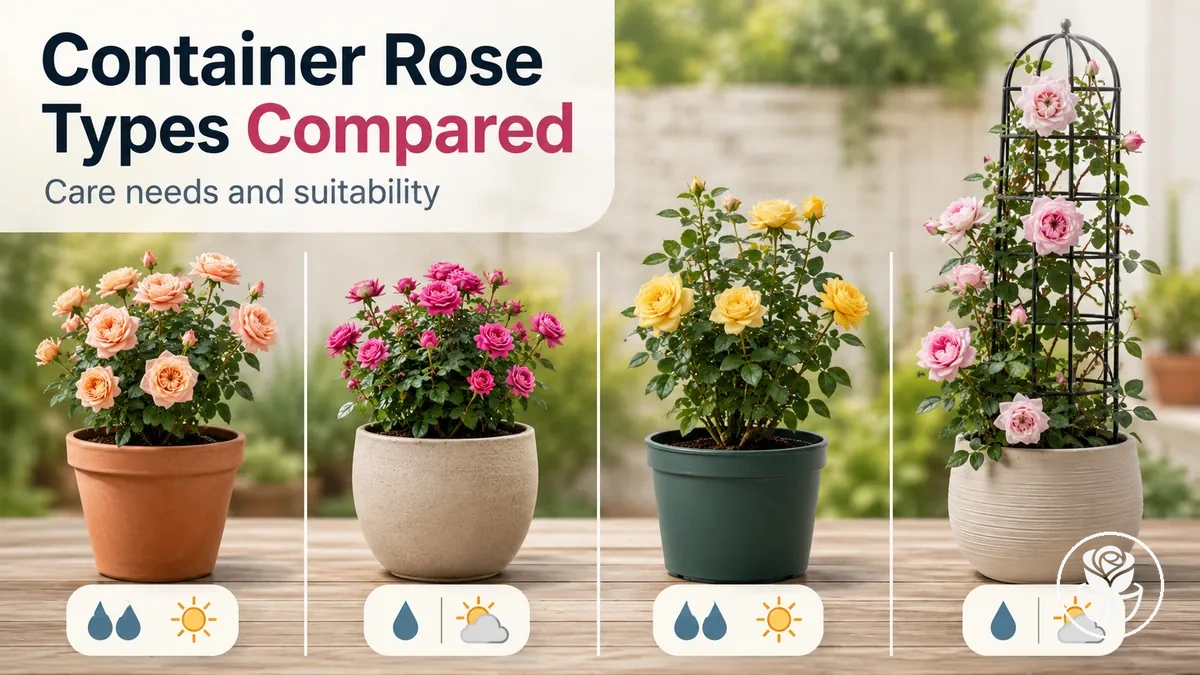
Container Rose Types for Pots Compared
Container rose types for pots differ by growth habit, container fit, care effort, and support needs, so the right choice depends on the growing situation rather than one universal type. Miniature roses, patio roses, compact roses, groundcover roses, smaller shrub roses, and climbing roses can each suit pots when root space, mature size, placement, and maintenance capacity match the plant’s needs. Container fit is the main decision condition.
A container rose type is a rose selection judged by growth habit and care-fit conditions inside a pot. The same rose type may be easier or harder to manage depending on root space, drainage, exposure, pruning response, and support needs. Compact types usually keep the decision closer to pot size and moisture monitoring, while support-heavy types add training pressure and stability checks. For the broader setup path, use the Container Rose Care System hub.
For a small pot or balcony, miniature roses and other compact roses may be more practical when the container is deep enough and moisture is monitored closely. For a patio or standard container, patio roses can offer a balanced display value when mature size and care effort remain manageable. For wider containers, groundcover or smaller shrub roses may work better when spread and spacing demand are planned. For vertical display, climbing roses need large containers, stable vertical support, and more training capacity before they become a realistic container choice.
Container Rose Types for Pots Compared below compares type, fit condition, care pressure, and best use case at a high level. Use it as a decision frame before checking detailed suitability traits in the next section.
| Rose type group | Fit condition | Care pressure | Best use case |
|---|---|---|---|
| Miniature roses | Small but sufficiently deep pots with drainage and close moisture monitoring | Lower placement pressure, but higher watering sensitivity in tight root space | Small balconies, compact displays, and beginner-friendly setups when routine care is consistent |
| Patio roses | Standard containers with enough root room for moderate mature size | Balanced care effort when pruning, feeding, and watering stay regular | Patios, entrances, and container displays that need compact growth with visible flower value |
| Groundcover or smaller shrub roses | Wider containers that can handle spreading or bushy growth | More spacing and pruning-shape pressure than tighter compact types | Fuller container coverage where container width and placement space are available |
| Climbing roses | Large containers with stable vertical support such as a trellis or support frame | Higher support needs, training pressure, and maintenance capacity | Feature-plant containers where vertical growth is wanted and support readiness is planned |
What Makes a Rose Type Suitable for Container Care
Rose type and container suitability depend on growth habit, mature size, root behavior, and care tolerance. A rose can be suitable for container care when these characteristics remain manageable within the limits of a pot and its growing environment. Pot success depends on fit.
Some rose types become harder to manage in containers because mature size, root behavior, or canopy growth can create container stress over time. Dense canopy growth may reduce airflow, while vigorous growth can increase maintenance effort and support demands. A favorable pruning response can help with size control when conditions allow. What Makes a Rose Type Suitable for Container Care becomes easier to evaluate when these suitability signals are reviewed together.
What Makes a Rose Type Suitable for Container Care can be assessed through a small set of suitability signals rather than through type names alone. The checklist below verifies traits that separate more container-friendly rose types from roses that may become harder to manage in pots.
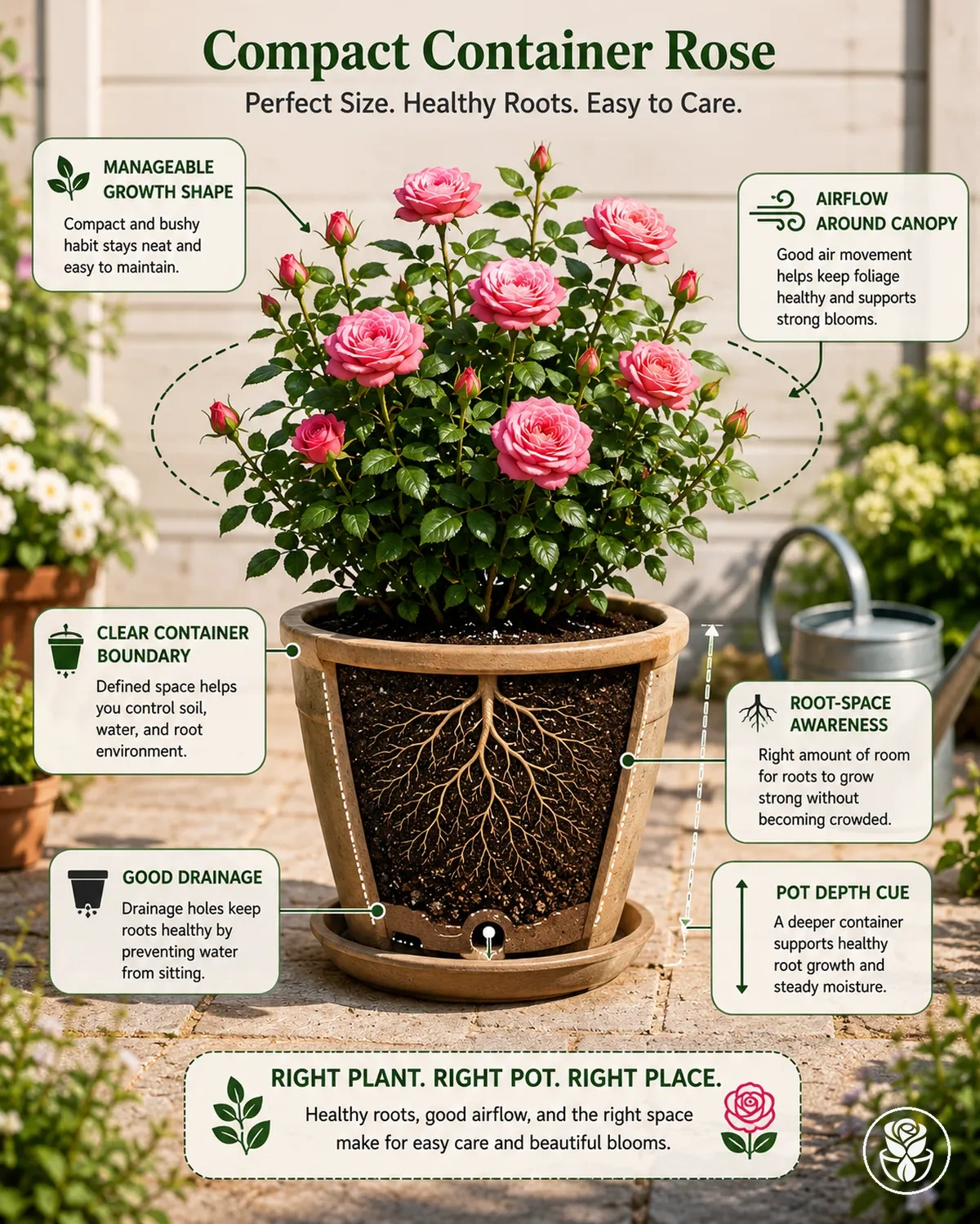
- Manageable growth habit: Controlled growth can make long-term container fit easier when space is limited.
- Moderate mature size: A mature size that remains proportional to the container may reduce crowding and placement pressure.
- Balanced root behavior: Root systems that adapt to available pot depth may experience less container stress when root space is adequate.
- Adequate airflow: Better airflow through the canopy may support healthier placement when growing conditions are suitable.
- Responsive pruning response: Good response to pruning can support size control when regular maintenance is possible.
- Practical care tolerance: Rose types with broader care tolerance may be easier to manage than types that react strongly to container limitations.
Detailed pot dimensions belong to container size requirements rather than this type-comparison section. Container sizing should be evaluated separately from rose type selection because root room and pot depth vary by growing situation.
Container Rose Types Compared by Growth Habit
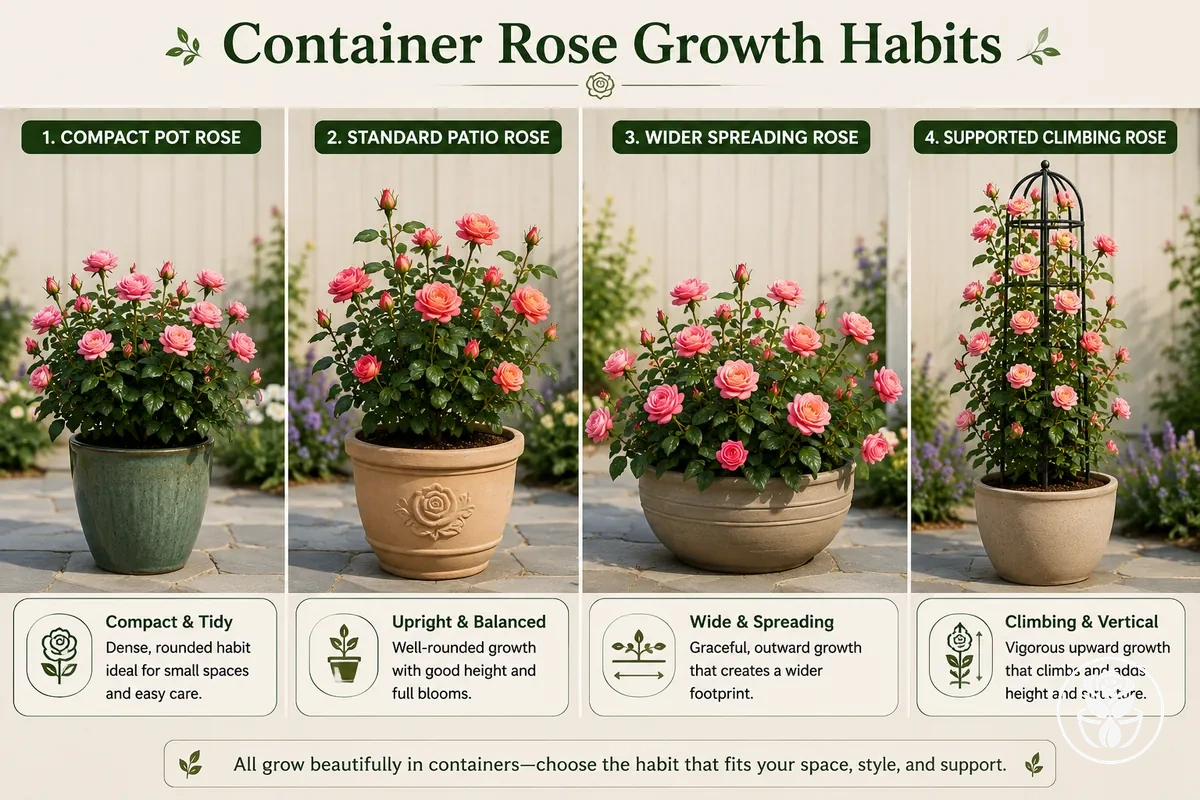
Growth habit is the main comparison lens because it directly influences pot fit, root demand, care burden, and long-term container management. Different rose type groups use container space differently through compact growth, spreading behavior, or vertical development. The comparison below focuses on growth habit, container condition, care burden, and best-fit situation.
Compact roses often place less pressure on container space when mature growth remains controlled. Groundcover roses may require wider containers because a spreading habit increases spacing demand. Climbing roses create different pot demands because vertical growth adds support need and training pressure. Container Rose Types Compared by Growth Habit becomes clearer when these growth patterns are viewed side by side.
Container Rose Types Compared by Growth Habit is illustrated below through a comparison graphic that highlights how different growth types influence container use and display style.
| Rose type group | Growth habit | Container condition | Care burden | Best-fit situation |
|---|---|---|---|---|
| Miniature roses | Very compact growth | Smaller containers with appropriate root room | Usually lower when growth remains controlled | Limited spaces and smaller pot displays |
| Patio roses | Compact, balanced structure | Standard container conditions | Often moderate when maintenance remains consistent | Patios and decorative container settings |
| Compact roses | Manageable height and spread | Containers with moderate root capacity | May remain balanced when pruning pressure stays manageable | General container gardening situations |
| Groundcover roses | Spreading habit | Wider containers with additional spacing | Can increase due to spread management demands | Broader container displays and edge coverage |
| Smaller shrub roses | Bushy growth type | Containers with room for mature development | May increase as canopy density expands | Fuller container presentations |
| Climbing roses | Vertical growth | Large containers with support structures | Usually higher when support need and training pressure increase | Vertical accents and supported displays |
Miniature Roses for Small and Deep Pots
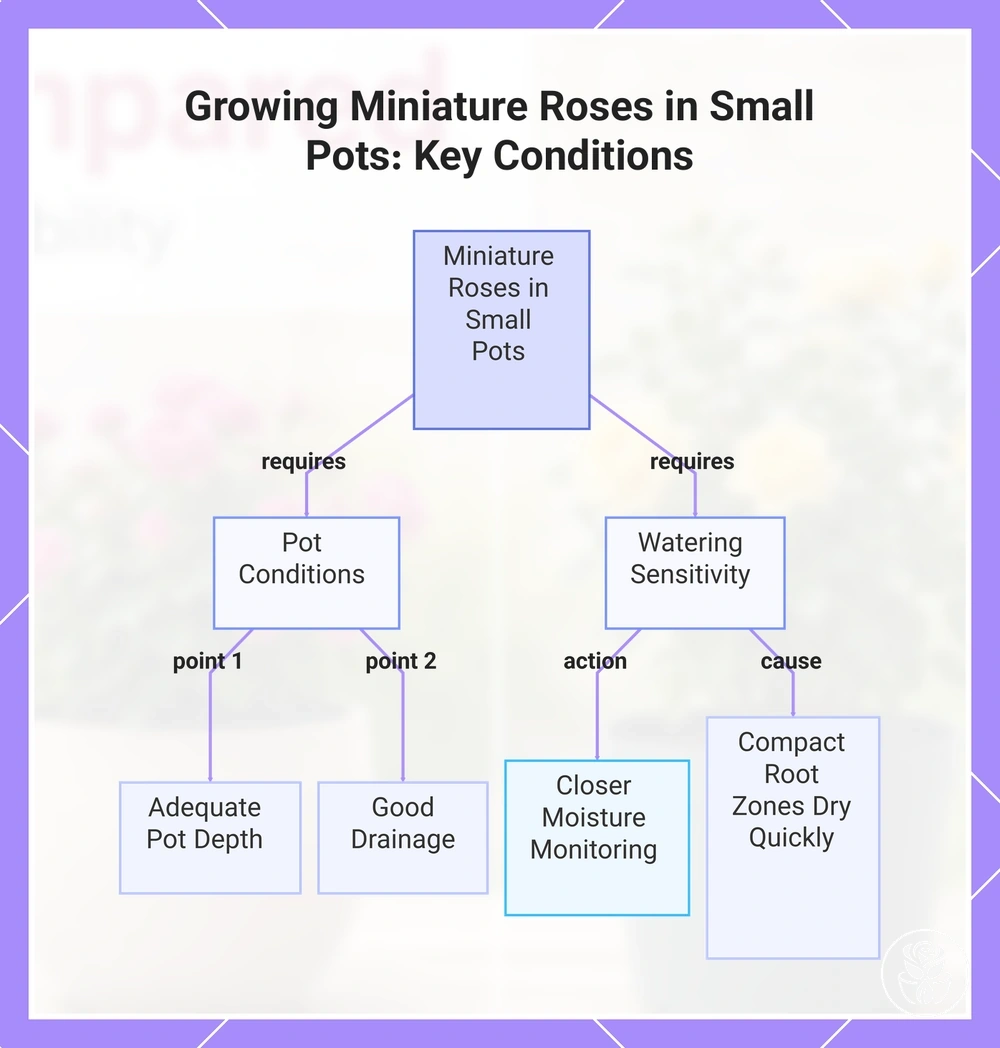
Miniature roses are compact candidates for small pots when the container still provides adequate depth, drainage, and root space. Their compact size can make placement easier in limited areas, but container success still depends on moisture monitoring. Watering sensitivity remains an important consideration even when growth stays manageable.
Miniature roses may fit small pots more easily than larger rose types, but small does not mean shallow or neglect-proof. Root restriction can increase stress when pot depth or drainage is insufficient, and watering sensitivity may become more noticeable in confined containers. A small but sufficiently deep pot is usually a more suitable condition than a shallow decorative container.
- Pot depth: Deep pots can provide more room for root development than shallow containers.
- Drainage: Good drainage may help reduce stress associated with excess moisture around roots.
- Watering sensitivity: Closer moisture monitoring is often needed because compact root zones can dry more quickly.
- Pruning: Light pruning may help maintain a manageable form when container conditions support healthy growth.
This chart shows the essential pot conditions and watering considerations for successfully growing miniature roses in small containers.
Patio and Compact Roses for Standard Containers
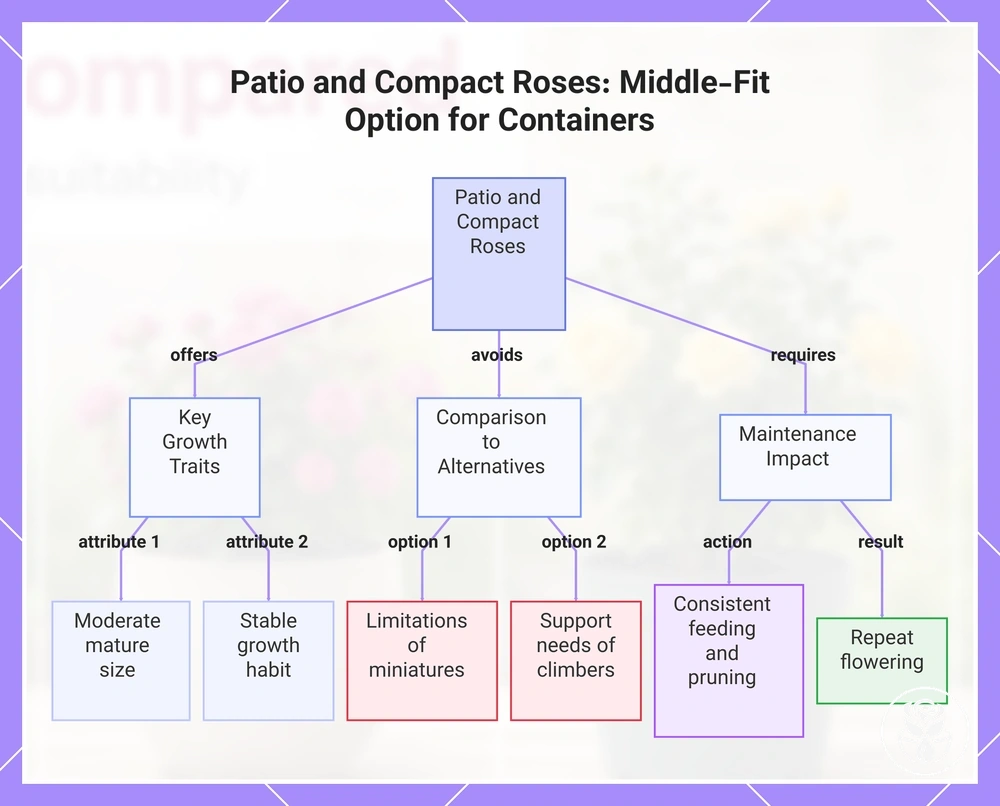
Patio roses and compact roses serve as middle-fit options in container rose selection because they combine moderate mature size with manageable height and stable growth. Their growth habit can support a balanced display while avoiding the limited scale of miniature roses and the higher support needs of larger climbing types. This combination often suits standard containers with good container stability.
When a container setup needs visible flowering and manageable growth, patio roses and compact roses can provide a practical balance between display value and care effort. Repeat flowering may contribute to ongoing visual interest when feeding, pruning, and maintenance remain consistent. Moderate mature size, container stability, manageable height, and balanced care are useful selection signals when choosing among container rose types.
This chart shows the key growth traits, comparison to other rose types, and maintenance factors that make patio and compact roses a balanced choice for standard containers.
Groundcover and Smaller Shrub Roses for Wider Containers
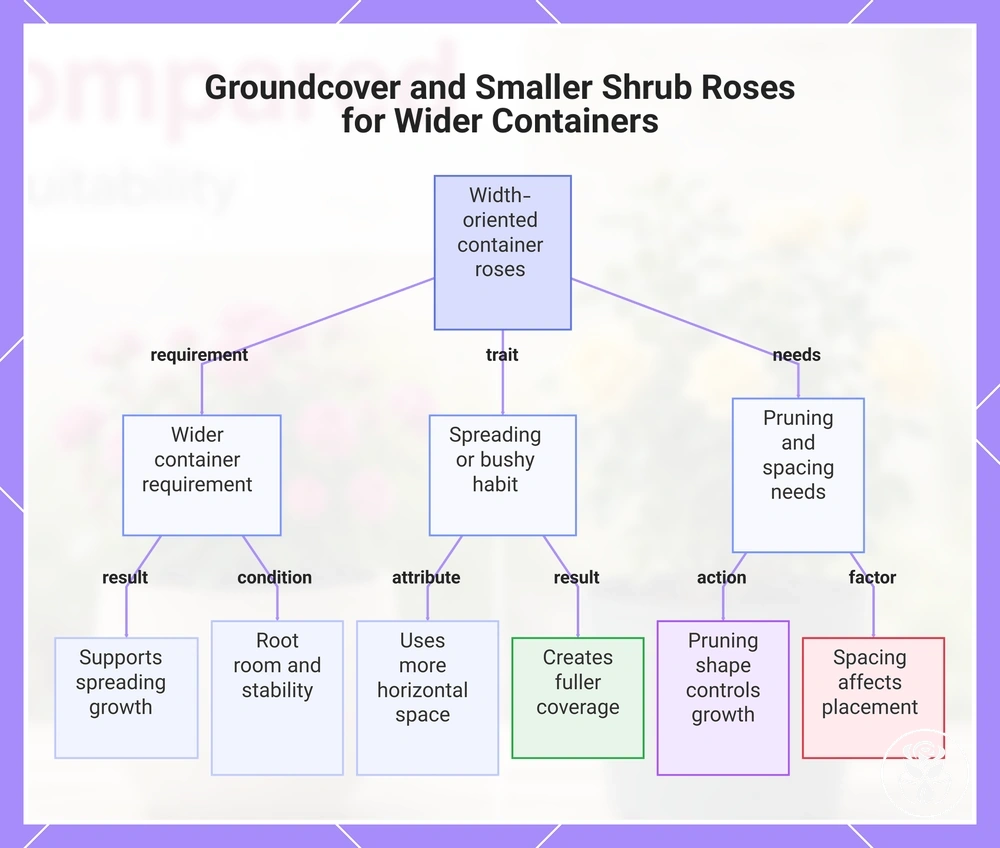
Groundcover roses and smaller shrub roses are width-oriented container choices because their spreading habit or bushy habit uses more horizontal space than height-focused compact roses. They can create fuller coverage in pots when container width, root room, and stability are suitable. Wider containers are usually the main requirement.
These rose types may become harder to manage when spread and canopy density exceed the available container footprint. Pruning shape can help keep growth more controlled, but spacing demand still affects placement and display use. The trade-off is fuller container coverage with greater width planning.
- Container width: Wider containers can support spreading or bushy growth with less crowding.
- Spread control: A spreading habit may need more spacing than compact upright roses.
- Pruning shape: Regular shaping can help maintain a manageable container outline.
- Display role: Fuller coverage may suit broad pot displays when placement space is available.
This chart shows the key requirement, growth trait, and management needs for using groundcover and smaller shrub roses in wider containers.
Climbing Roses for Large Containers and Vertical Support
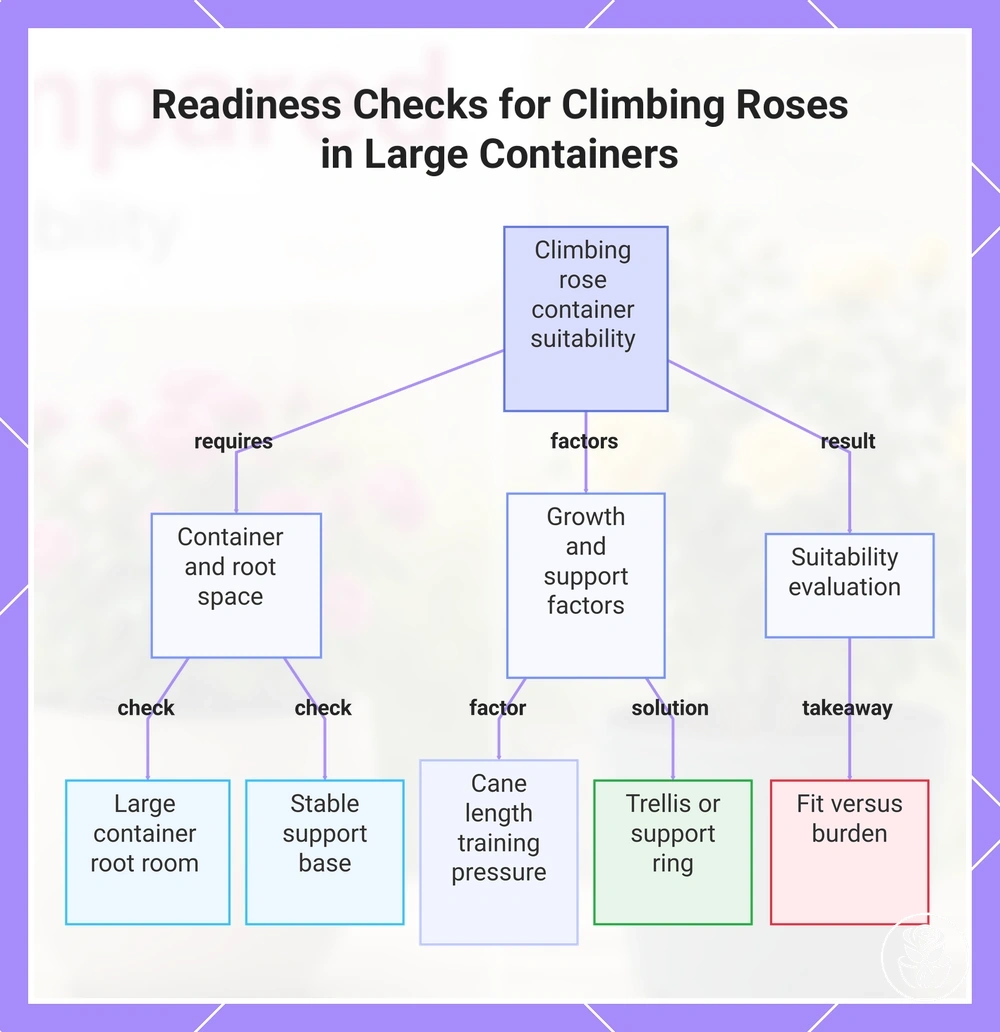
Climbing roses can work in containers when large containers provide adequate root room and stable vertical support. Their cane length and vertical growth usually require more support and training than compact rose types, so container suitability depends on both space and structure. Feasibility improves when large containers and support readiness are in place.
Training pressure may increase as cane length develops and growth extends upward. A trellis or support ring can help stabilize a trained rose, but weak supports or limited placement space may reduce container suitability. Climbing Roses for Large Containers and Vertical Support can be evaluated using the readiness checks below.
- Root room: Large containers should provide sufficient space for continued growth.
- Stable support: Vertical growth depends on a secure support base.
- Cane length: Longer canes may increase training pressure and placement demands.
- Trellis or support ring: Support structures can assist with guidance and stability.
- Fit versus burden: Vertical display value may improve when support conditions are adequate, but maintenance needs can also increase.
This chart outlines the container and support requirements, growth factors, and overall evaluation for climbing roses in large containers.
Comparison Criteria for Choosing a Container Rose Type
Comparison criteria control container rose selection more effectively than choosing a single rose type by name alone. The most suitable choice depends on how rose type, root space, mature size, sunlight tolerance, bloom value, disease pressure, support requirement, care effort, and display goals work together. These criteria provide the decision frame.
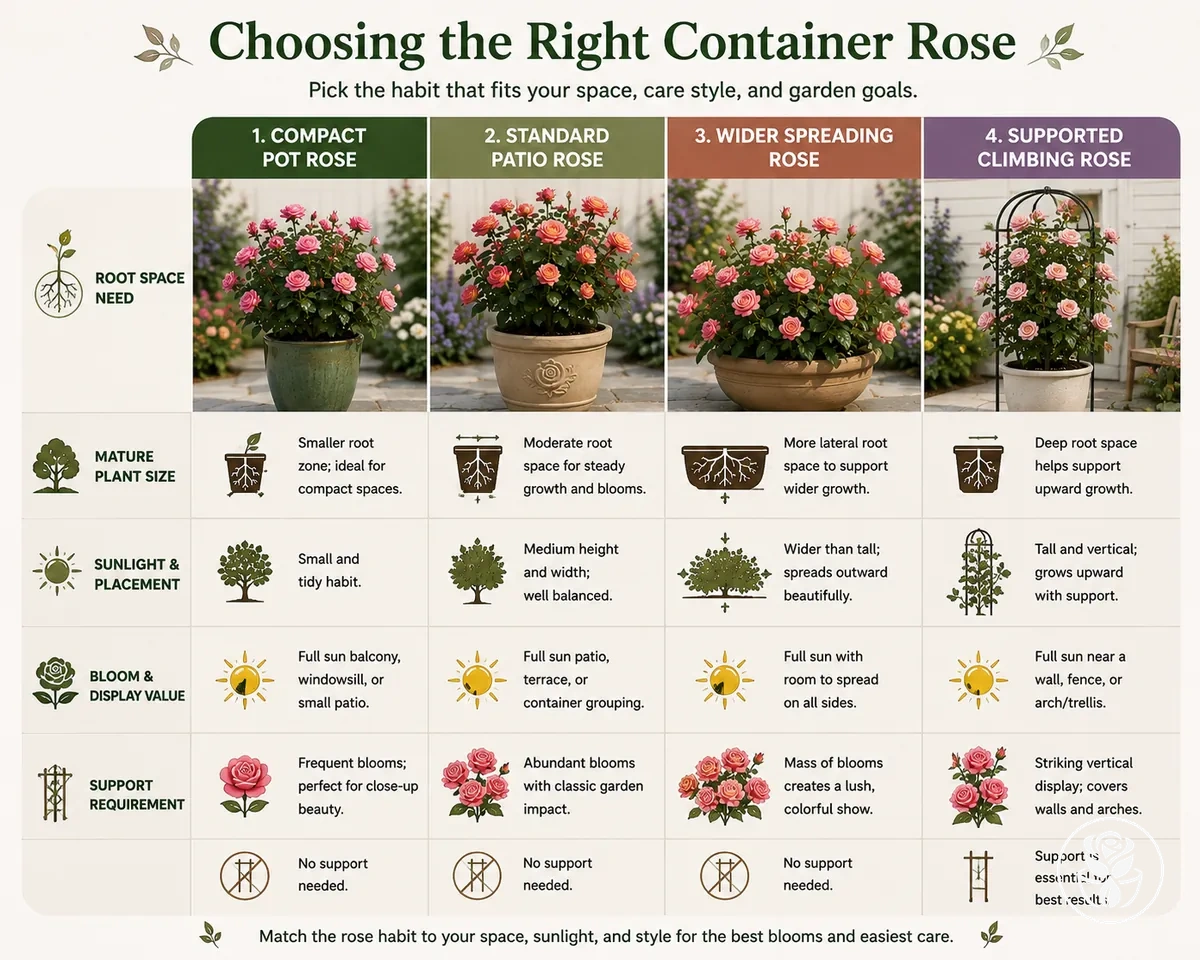
Selection criteria can help prevent mismatches between container conditions and rose growth habits. A rose type that suits display goals may still create challenges if root space, support needs, or care effort exceed available capacity. Essential fit criteria should be evaluated alongside preference criteria rather than treated as isolated factors. Comparison Criteria for Choosing a Container Rose Type organizes these decision factors visually and in the table below.
| Criterion | What to check | Favorable condition | Decision effect |
|---|---|---|---|
| Rose type | Growth habit and container fit | Growth remains manageable for the container | Helps align type with available space |
| Root space | Container capacity and root room | Adequate room for expected growth | Supports long-term container suitability |
| Mature size | Expected height and spread | Size remains proportional to placement limits | Reduces crowding risk |
| Sunlight tolerance | Placement and light exposure | Light conditions match growing needs | Improves placement fit |
| Bloom value | Flower display and fragrance preferences | Display characteristics match display goals | Supports visual satisfaction |
| Disease pressure | Airflow and growing conditions | Conditions may support healthier growth | Influences maintenance expectations |
| Support requirement | Need for trellis, support ring, or training | Support needs match available setup | Affects care effort and suitability |
These comparison criteria connect essential fit factors with preference-based considerations, helping weigh space, care effort, and display goals together. For a broader evaluation process, use the buying checklist.
Root Space, Mature Size, and Container Fit
Root space and mature size determine container fit more than label names alone because root demand and final size affect how a rose uses available container conditions. A rose type that appears compact early may require more room as mature size and canopy spread develop. Container fit depends on adequate pot depth and root space.
Stress risk and maintenance burden may increase when mature size or root demand exceed available container capacity. A rose may outgrow a pot or become less stable when canopy spread, root demand, or container conditions no longer support expected growth. Exact sizing belongs to dedicated container size requirements, while Root Space, Mature Size, and Container Fit can be verified through the checklist below.
- Pot depth: Container depth should support expected root demand.
- Root room: Available root space may affect fit and long-term container performance.
- Canopy spread: Mature spread should remain compatible with placement conditions.
- Stability: Container stability may become more important as mature size increases.
Sun Exposure, Airflow, and Placement Tolerance
Placement tolerance depends on sun exposure, airflow, and container conditions because these factors affect which rose type is practical in a specific location. A rose type with suitable exposure tolerance may be easier to manage than a denser type when canopy density, balcony exposure, or heat stress increase local growing pressure. The decision depends on the exposure condition.
Airflow and heat stress can affect placement fit by changing disease risk, bloom performance, and watering pressure. Dense canopy growth may increase disease risk when air movement is limited, while stronger balcony exposure may increase watering pressure under certain container conditions. This subsection evaluates rose type fit under placement conditions only; detailed guidance belongs to sunlight and placement needs.
- Sun exposure: Light exposure should align with the rose type and expected bloom performance.
- Airflow: Better air movement may reduce pressure associated with dense canopy density.
- Heat stress: Higher exposure can increase growing pressure depending on climate and container condition.
- Disease risk: Limited airflow may increase risk when humidity and canopy density are higher.
- Watering pressure: Exposure and container conditions can increase moisture-monitoring needs.
Bloom Habit, Fragrance, and Display Value
Display value matters after fit and care needs because bloom habit, fragrance, and ornamental value are secondary selection factors for a container rose type. A rose type may match a container setting visually, but bloom frequency, flower size, and maintenance expectations still influence long-term satisfaction. Display value should be weighed against the care trade-off.
In a decorative container setting, fragrance, scent, flower size, and visual mass can shape display expectations and personal preference. Bloom habit may affect display impact, while larger flowers or greater visual mass can influence feeding need, pruning attention, or placement expectations. The resulting display value depends on the container setting and its associated care implication.
- Bloom habit: A more noticeable flowering habit may increase feeding or pruning needs.
- Fragrance: Scent preference can influence selection, but fragrance should remain secondary to fit and care criteria.
- Flower size: Larger flower size may affect display expectations and maintenance attention.
- Visual mass: Fuller visual presence can improve display impact while increasing care considerations in certain container settings.
Care Difficulty Across Container Rose Types
Care difficulty depends on the care burden created by the rose type and the container conditions around it. Watering sensitivity, pruning frequency, disease risk, feeding need, and support burden can increase or reduce maintenance difficulty depending on growth habit, placement, and container size. These care attributes create the main maintenance effect across container rose types.
For a beginner, a rose type may feel more manageable when monitoring needs remain predictable and container conditions stay stable. In small spaces, canopy density and watering sensitivity can increase care effort when airflow is limited. For high-display expectations, feeding need and pruning frequency may require more attention to maintain the desired appearance. The matrix below compares care difficulty through care burden and growing conditions rather than fixed labels.
Care Difficulty Across Container Rose Types depends on how each rose type group interacts with its container environment. Easier and harder conditions help clarify where maintenance demands may increase.
| Rose type group | Easier condition | Harder condition | Main care burden | Beginner note |
|---|---|---|---|---|
| Miniature roses | Consistent moisture and suitable container depth | Heat exposure with limited monitoring | Watering sensitivity | May suit beginners who can check moisture regularly |
| Patio and compact roses | Routine care with balanced growing conditions | Irregular pruning or feeding schedules | Pruning frequency and feeding need | Often manageable when maintenance remains consistent |
| Groundcover roses | Wide containers with adequate spacing | Restricted space with spreading growth | Size control and pruning frequency | Care effort may increase as spread expands |
| Smaller shrub roses | Good airflow and suitable container room | Dense canopy growth with limited airflow | Disease risk and canopy management | Manageability depends on placement conditions |
| Climbing roses | Large containers with stable support | Limited support or constrained vertical space | Support burden and training effort | May become easier to manage when support is planned early |
Beginners comparing rose type groups can use beginner-friendly container care as an additional reference when interpreting maintenance demands.
Easier Container Roses for Beginners
Easier container roses for beginners are usually compact, manageable, and tolerant of routine care when the container setup is appropriate. Beginner-friendly roses may be easier to monitor and adjust, but they still require attention to watering, feeding, sunlight, and drainage. Their suitability depends on appropriate setup and consistent routine care.
Beginners often encounter fewer maintenance challenges when growth habits remain predictable and care effort stays manageable. Lower training need and simpler pruning can reduce common support and size-control mistakes. The beginner-friendly signals below help identify manageable rose types while preserving the need for routine care.
- Controlled size: Compact growth can reduce errors related to overcrowding and size management.
- Lower training need: Reduced dependence on supports can help reduce setup and guidance mistakes.
- Simpler pruning: Manageable growth habits can help reduce pruning errors during routine care.
- Visible stress cues: Earlier signs of watering or drainage issues can support quicker adjustment.
- Manageable growth habit: Predictable development can reduce care effort while still requiring routine monitoring.
Higher-Maintenance Types That Need More Space or Training
Higher-maintenance types need more space or training because cane growth, spread, and support requirements can increase ongoing care effort. Maintenance risk may increase when container volume, pruning access, or support conditions do not match the growth habit. Readiness depends on whether these conditions are available before selecting a demanding type.
Demanding types are not poor choices when container volume, support stability, and training access fit the rose type. Larger rose types can become feasible high-effort choices when space and support conditions are adequate, while poor-fit high-effort choices may increase maintenance risk or failure risk when those conditions are missing. Higher-Maintenance Types That Need More Space or Training should be evaluated with the readiness checklist below.
- Container volume: Verify that available root room can accommodate expected cane growth and spread.
- Support stability: Confirm that support requirements can be maintained as growth develops.
- Pruning access: Ensure that growth remains accessible for size control and training.
- Placement space: Check that surrounding space can support spread, height, and support needs without creating avoidable maintenance pressure.
Support and Training Needs by Rose Type
Support and training needs depend on growth habit and pot stability because different rose types place different demands on shaping, stability, and structural control. A rose type with limited vertical growth may need little more than occasional guidance, while stronger cane growth can increase training pressure over time. The key distinction is whether support serves optional shaping or necessary structural control.
Training pressure can increase when growth extends beyond the natural stability provided by the container setting. A ring, stake, or trellis functions differently depending on the rose type, support base, and growth habit. Pot stability can influence how effectively plant support helps maintain shape or control growth. Support and Training Needs by Rose Type can be compared through the compatibility table below.
| Rose type | Support need | Training pressure | Container stability concern | Decision cue |
|---|---|---|---|---|
| Miniature roses | Usually low; support may be optional for shaping | Low | Limited concern when growth remains compact | Shaping support may be sufficient |
| Patio and compact roses | Ring or stake may help maintain form | Moderate | Depends on plant size and pot stability | Support often assists shape rather than structural control |
| Groundcover and smaller shrub roses | Usually focused on shaping rather than vertical support | Moderate | Spread may affect balance and maintenance access | Support use depends on growth pattern |
| Climbing roses | Trellis or other vertical support may become necessary | Higher | Support base and pot stability become more important | Structural control may be needed as cane growth develops |
Best Container Rose Type by Growing Situation
The best-fit choice depends on the growing situation because space, support readiness, display value, and care condition influence which rose type attributes are most suitable. A compact growth habit may fit a small balcony, while a larger growth habit may fit a patio or large pot when support readiness and maintenance capacity are available. Best Container Rose Type by Growing Situation should be evaluated through fit scenarios rather than a single universal answer.
A small balcony often favors compact height, stable pot conditions, and low support demand. A beginner tolerance scenario may favor manageable growth and routine care over maximum display value. A feature plant situation may favor stronger visual presence when container space supports it. A support-ready container setting may accommodate growth habits that trade additional care effort for display value. The decision table below matches each growing situation to type traits and decision outcomes.
| Growing situation | Type traits to favor | Type traits to avoid | Why it fits |
|---|---|---|---|
| Small balcony | Compact height, manageable spread, low support demand | Large spread and higher training needs | Matches limited space and stable pot conditions |
| Beginner tolerance | Manageable growth, routine care, moderate care effort | High training pressure and intensive maintenance | Can simplify ongoing care conditions |
| Feature plant in a patio or large pot | Strong display value and fuller visual presence | Growth traits that exceed available container space | Supports display goals when space is available |
| Support-ready container setting | Growth habits compatible with training and support readiness | Traits that conflict with available support conditions | May suit situations where additional care effort is acceptable |
For a broader decision process that combines growing situation, care condition, and selection criteria, use the buying checklist.
Small Balcony and Patio Choices
Small balcony and patio choices depend on rose type traits such as compact height, controlled spread, stable pot fit, and low support demand. These traits can improve container suitability when limited floor area restricts placement options. Exposure remains a condition that may influence practicality within the available space.
When space is constrained, compact rose types may fit more easily than oversized climbing or spreading habits that require additional room or support. For example, a compact rose may suit a patio container where limited floor area creates a constraint on growth and movement around the pot. The practical suitability depends on balancing container fit with manageable care needs.
- Compact height: Favors small-space choices where vertical room is more limited.
- Controlled spread: Helps maintain container fit when floor area is restricted.
- Stable pot fit: Supports practical placement and reduces crowding pressure.
- Low support demand: May simplify care when space for additional support is limited.
Large Pot and Feature-Plant Choices
Large pot and feature-plant choices depend on root room, height allowance, support possibility, and the intended display goal. A larger container can allow more display-oriented rose type choices because additional root room may support greater size and structure. The care trade-off is that increased display value may also increase watering, feeding, pruning, or support expectations.
When the goal is a feature plant, rose type choice should balance visual outcome with available care capacity. A compact shrub, patio rose, or climbing rose may suit a large pot when container capacity aligns with growth habits and support readiness. The visual outcome can become more prominent as size increases, but maintenance expectations may increase as well.
| Type trait | Best large-pot use | Added care expectation |
|---|---|---|
| Compact shrub | Display planting with controlled structure | Pruning and feeding may increase as growth expands |
| Patio rose | Feature plant with manageable proportions | Routine feeding and shaping may be needed |
| Climbing rose | Display planting where support possibility exists | Training, pruning, and support management may increase |
Common Questions Before Choosing a Container Rose Type
Should I choose a container rose type based on flower appearance alone?
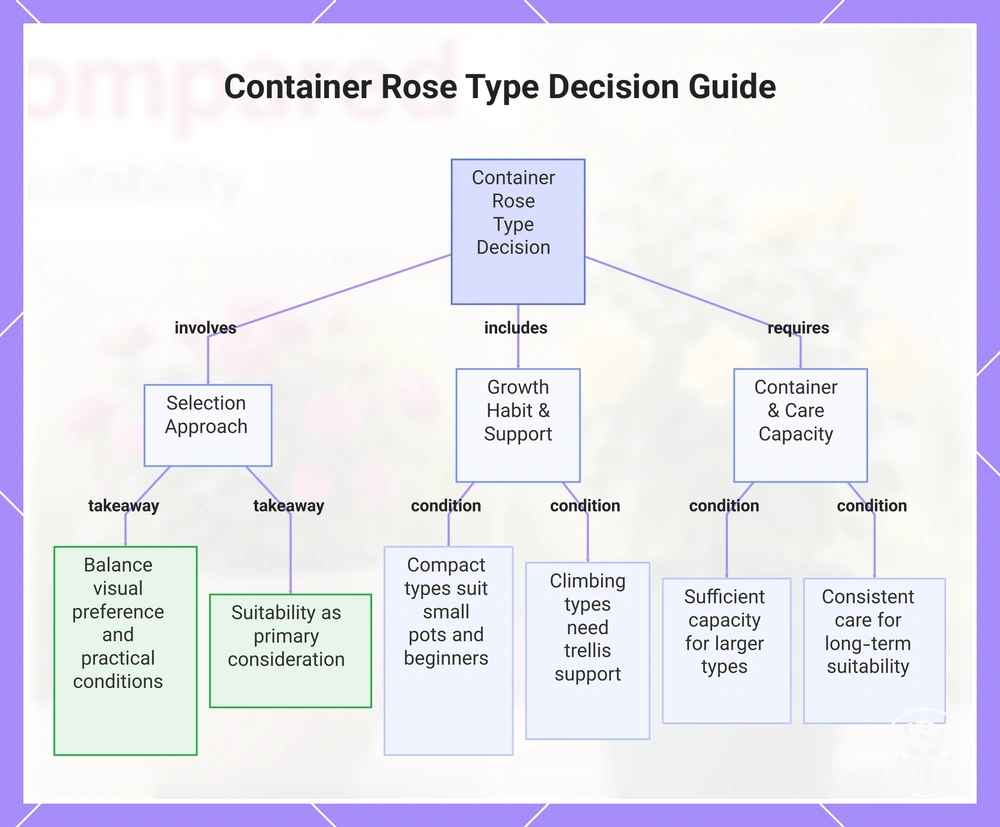
No. Flower appearance is only one factor when you choose a container rose type. Suitability also depends on growth habit, container conditions, root space, and expected care effort. A rose type decision should balance visual preference with practical growing conditions.
Can roses grow in small pots?
Yes, some rose types can grow in small pots when drainage, root space, and growth habit remain compatible. Miniature roses and other compact choices are often more suitable for restricted containers. Long-term suitability depends on how growth develops within the available space.
Is a compact rose a good beginner choice?
Often yes. A compact growth habit may make routine care more manageable for a beginner choice. The final suitability depends on consistent care and appropriate container conditions.
Do all container rose types need support?
No. Support need depends on the growth habit of the container rose type. Climbing roses may benefit from a trellis or other training structure, while compact types often require less support. Support readiness should be part of the rose type decision.
What is the most important factor when I select a rose type?
Suitability is usually the primary consideration. Container conditions, growth habit, root space, and care effort should align with the intended use. A rose type may be less suitable when those conditions create ongoing constraints.
How do I know whether a larger rose type is appropriate?
A larger rose type may be appropriate when container capacity, support readiness, and available growing space are sufficient. A larger growth habit can support a stronger visual outcome, but it may also increase maintenance demands. The decision depends on available care capacity.
For broader guidance beyond these residual questions, visit the Container Rose Care System hub.
This chart shows the main considerations when selecting a container rose type, including visual preference, growth habit, container capacity, and care requirements.